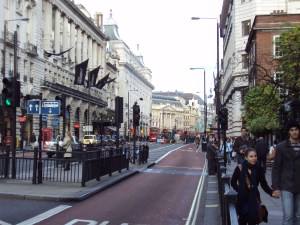
 This morning’s short walk through London’s central street evoked unconnected thoughts, few of them joyous. But an observation first.
When in France, I often have traffic accidents, on foot. When someone is walking right at me in the street, my natural instinct is to move to my left. A continental just as naturally moves to his right, and I’ve often collided with a Frenchman, both of us profusely apologetic.
Par for the course, one supposes. But not, one would think, in England. Well, one would think wrong.
The human throng was moving through Piccadilly along the right side of the pavement, just like in Paris and other objectionably foreign places. That stands to reason: people who naturally move on the left make up a meagre 40 per cent of London’s population, and less so in Piccadilly: the place was crawling with tourists, each toting a shopping bag from a trendy London shop.
Being congenitally bloody-minded, I made a point of walking against the current on the left, bumping into people along the way. Some of them were unmistakeably English, complete with pinstripe suits clashing with striped shirts and I’m-English-and-I-don’t-give-a-damn ties. Traitors, I thought, leading with my shoulder and pushing hard with my feet.
Given my CV, I can hardly be accused of being a jingoistic Little Englander, but there’s something wrong in our capital having been house-trained to develop continental instincts.
When I’m in France, I’m often asked if I spend much time with English expats. No, I invariably reply, when I’m in France I want to be with the French. I can be with the English in England. Well, that doesn’t seem to be an option in Piccadilly.
That was merely an observation – now comes a thought inspired by the same walk. A new commercial building has just gone up on the northern side of the street, ready to receive its share of shops and restaurants.
I made a mental note that, while not being particularly interesting, the building was inoffensive, nothing about it jarred, which is rare nowadays. The shops and restaurants hadn’t yet moved in, their signs hadn’t been put up yet, and the building was part-wrapped in plastic bearing the builder’s logo.
In a month or two no one will remember the builder’s name, while everyone will know the building by the shops and restaurants housed there. Yet the builder’s name is the only thing that’ll never change for the building’s lifetime. In a few years the restaurants and shops will all be replaced by others, which then will establish the building’s new identity.
Yet again this illustrates the modern triumph of flighty over constant, changeable over immutable, transient over transcendent. Walking past several great bookshops in Piccadilly one gets another confirmation of this tendency. Their windows are full of books that won’t be remembered in a year’s time, but today’s merchandising experts aren’t about past grandeur. They’re after today’s sales. It’s transient over transcendent again.
Similarly, people insist in discussing Brexit strictly in economic terms. Never mind our constitution lovingly developed over 1,000 years. What matters is economic indicators, which everyone knows from experience will change next week, if not tomorrow.
Actually, my thoughts took a philosophical turn to take my mind off the dental appointment awaiting me at the end of the walk. Only a clean-up, but show me a man who cherishes dental visits, and I’ll show you a masochist.
I didn’t cherish mine, but neither did I dread it very much. My hygienist had something to do with mitigating the sense of foreboding: she’s a good-looking New Zealand woman, a year or two on either side of 30. Almost as important is her utmost competence and talent for going about her business without any sadistic excesses.
I was in for an unpleasant surprise: when I got to the practice, she was no longer there. Her work visa hadn’t been extended, and she had had to go back to New Zealand.
One would have thought that any decent barrister would argue that such banishment constituted cruel and unusual punishment, words first used in the 1689 English Bill of Rights. However, the Home Office could have argued back that, cruel though the punishment might be, it’s by no means unusual – they are merciless to professional immigrants raised in a culture similar to ours.
Now, mass immigration is in vogue these days, and one is allowed to voice dissenting views, provided they are expressed in arithmetical, rather than demographic, terms. But between us boys, it’s not just how many immigrants we admit that matters, but also what kind.
At the risk of having my disclaimer about not being a Little Englander overridden, I’d suggest that a New Zealander practising dental hygiene should be more welcome than a Somali practising female circumcision. Yet the reverse is true: it’s next to impossible to get rid of the latter, while disposing of the former is child’s play.
Amazing what kind of thoughts get into one’s head during a quiet walk on a sunny autumn day. No rhyme or reason, if you ask me. Just a bit of sadness.
 Have our courts set out to undermine any residual respect for the law?
 Alexander Kuprin (d. 1938) is less widely known in the West than his friends Chekhov and Bunin. However, he’s still venerated in Russia, and in the early twentieth century Kuprin rivalled his friends’ popularity. His 1905 novel The Duel sold 45,500 copies, which was remarkable in a country most of whose 126 million denizens either couldn’t read or didn’t have Russian as their first language.
 Ford (d. 1947) has become an icon worshipped even by socialists, never mind chaps called conservatives in the US. One such socialist is Piers Morgan, who lost his editorship of The Daily Mirror because of a phone-hacking scandal and his American chat show because of poor ratings.
 Jean Claude Juncker, or Junk, as he likes to be known to his friends, among whom I proudly number myself, put his finger right on it when he ascribed the Brexit vote to “40 years of lies”.
 Business Secretary Greg Clark studied at Cambridge and got a PhD from the LSE. Yet his speech isn’t that of an educated man.
 Actually, the kind of voices I mean don’t reach Russian ears either: their mass media are controlled by the KGB junta, while all opposition websites are blocked for internal consumption.
 A similar line was used, hilariously, by the late comedienne Caroline Aherne. The target couple were Debbie McGee (young and good-looking) and the popular conjurer Paul Daniels (neither).
 Now that my friend has resigned his parliamentary seat, a void has appeared in my life. Or rather it has broadened, for the void dates back to July, when Dave left 10 Downing Street.
 …to turn even clever men into blithering idiots.